New report finds tax cuts benefit highest-income Idaho households most
Meanwhile lowest-income families have seen taxes increase due to changes since 2018, report finds

A new report published this month by a Boise-based nonprofit organization found that state and federal income tax cuts have benefited the highest-income Idaho households the most, while low-income families are actually paying more.
The Idaho Center for Fiscal Policy published the findings in the new report, “How federal and state tax cuts shift costs onto Idaho families and communities.”
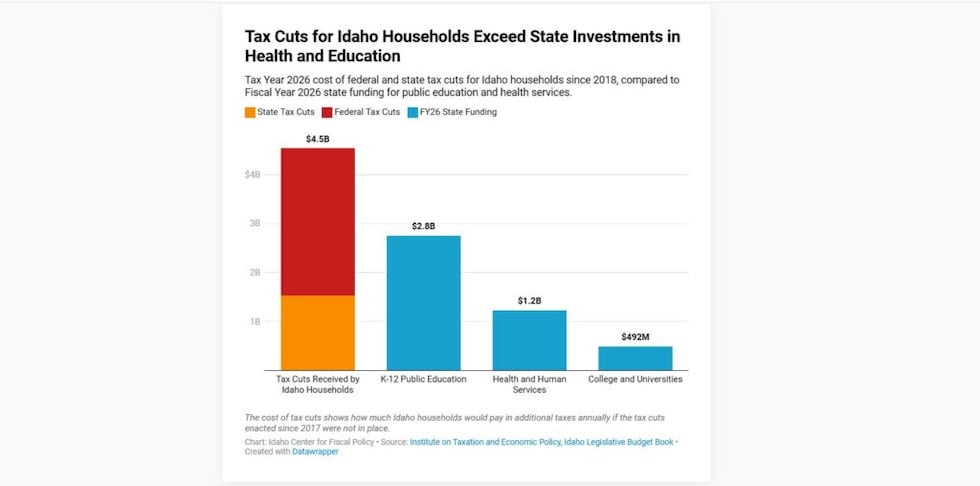
The report’s author, Policy Analyst May Roberts, tracked $4.5 billion in annual state and federal income tax cuts that Idaho households have received since 2018.
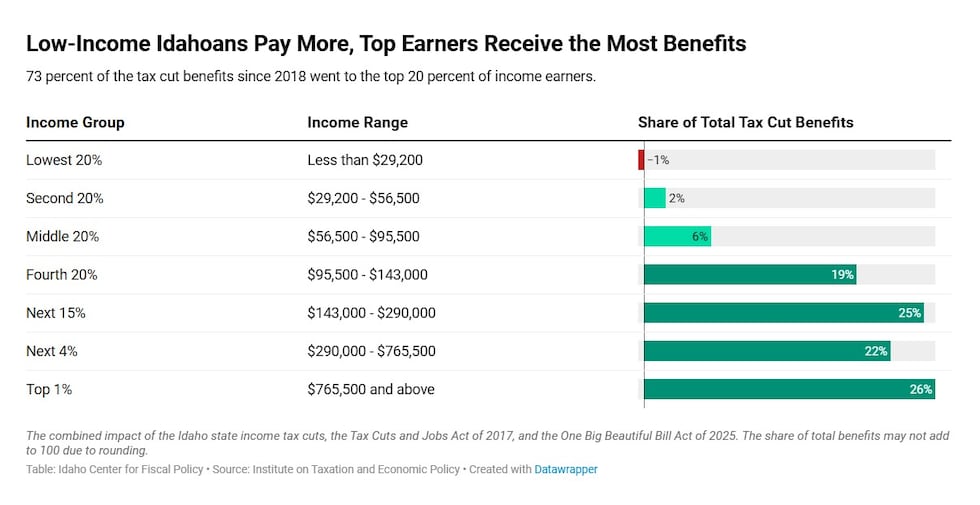
In a report from the Idaho Capital Sun, the report found that 73% of the benefits of those cuts went to the top 20% of households, those that earn $143,000 or more each year.
The report also found that Idahoans with the lowest incomes – those earning less than $29,200 annually – saw their taxes increase by an average of $96 per year.
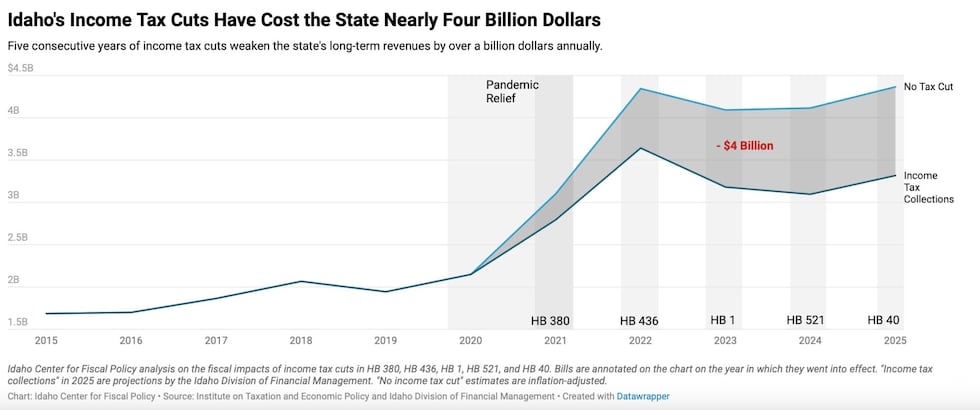
Since 2021, the Idaho Legislature has enacted several tax cuts that have reduced state revenue. Here are a few examples:
- House Bill 380, 2021 legislative session: The law reduced all income tax brackets, reduced the number of tax brackets from seven to five and reduced the top corporate and income tax brackets to 6.5%
- House Bill 436, 2022 legislative session: The law reduced the number of tax brackets from five to four, reduced individual income tax rates, lowered the corporate income tax rate to 6% and provided a one-time tax rebate.
- House Bill 1, 2022 special legislative session: The law created a flat income tax system by reducing the number of tax brackets to one, reduced the corporate and income tax rates to 5.8%, provided a one-time tax rebate and provided funding taken from sales tax collections for the public school income fund.
- House Bill 521, 2024 legislative session: The law reduced the income tax rate from 5.8% to 5.695% and provided additional money from sales tax collections to funds for public schools.
- House Bill 40, 2025 legislative session: The law reduced the income tax rate from 5.695% to 5.3% and made other tax changes.
Balancing tax cuts and public services
The increase in taxes among the lowest-income earners was due, in part, to the Idaho Legislature allowing the state child tax credit to expire and the federal One Big Beautiful Bill Act not extending premium tax credits that helped Idaho families and small business owners afford health insurance, the report stated.
“Tax cuts can be a valuable tool for helping families make ends meet, but it is important to look at who benefits and who bears the costs,” Roberts said in a written statement. “A fair tax system can provide meaningful tax relief while maintaining the essential services Idaho families rely on. When tax cuts significantly reduce the resources available for public services, the costs do not disappear — they are shifted onto families and local communities through higher property taxes, rising tuition and fees, reduced services and growing barriers to accessing healthcare and food assistance.”
Sen. Scott Grow, a Republican from Eagle who serves as co-chair of the Idaho Legislature’s Joint Finance-Appropriations Committee, supports the tax cuts.
“I am a fiscal conservative,” Grow said. “As (certified public accountants), we try to help our clients to make sure they pay a fair amount of tax and not overly pay. What we are hearing from our constituents is that they are concerned about high taxes, whether it be property tax or income tax. We try to be very fiscally conservative. I believe in limited government. We need to fund the government appropriately, and I feel like we do that.”
Tax cuts exceed state investment in key services like healthcare and education, report finds
The report also found that the combined $4.5 billion in tax cuts exceeds the Idaho Legislature’s fiscal year 2026 state funding for K-12 public education, colleges and universities and health and human services. The report said that for fiscal year 2026, there was $2.2 billion in state funding for K-12 public education, $1.2 billion for health and human services and $492 million for colleges and universities.
After the Idaho Legislature cut funding for colleges in universities in fiscal year 2026 and fiscal year 2027, the Idaho State Board of Education approved tuition increases, Idaho Education News reported.
“These examples illustrate how state-level budget cuts can shift costs to local governments and directly onto Idahoans,” the Idaho Center for Fiscal Policy’s new report states.
More information about the Idaho Center for Fiscal Policy and its research is available online.
Copyright 2026 KMVT. All rights reserved.